
Tze-ki Hon
Jointly appointed at
Beijing Normal University (Zhuhai campus)
Beijing Normal-Hong Kong Baptist University
Introduction
In everyday life, we are conditioned by habitual structures: the 24-hour clock, the 7-day week, the hierarchy in workplace, the social norms, the behaviour codes, the obligations for friends and family and so on. These structures are not strictures because they allow us to be humans, to be fully responsive, responsible members of a community. While these structures enhance our humanness, they shield us from a bigger world—the incessant unfolding of energies and forces in the ever-changing universe. To fulfil our duties, we become less attuned to the other possibilities and options that seem unimportant to our friends and family. To complete our tasks, we become less spontaneous to connect to forces or players that are not directly related to our concerns. In normal days, our failure to attune to the changing environment is completely acceptable. We trade off spontaneity and openness to focus our full attention on matters dearest to us.
Yet, when an unexpected event happens—such as a traffic accident, a family member dies prematurely, being layoff at a short notice, or losing a lot of money in the stock market—we realize that we cannot solely rely on norms and routines to regulate our lives. Rational thinking, even predictions based on the most advanced computer models, cannot shield us from unexpected outcomes. We realize that we must look for new possibilities or options because the world is never static and predictable. At this moment, we begin to resonate with the fluidity of life—the millions of possibilities that are surrounding us every day, the myriad forces that make this world a beautiful place to live, and the unseen web of relationships that make the world an intricately entangled system. With this awakening, we begin to see the world anew. Now we see the world as a gigantic web of relations that is evolving and entangling every moment. We find out that the world is ever-changing because one element of the system moves, all other elements respond. We discover that the world is intricately related because all elements in the system—regardless of how remote they are, or how seemingly unrelated they appear—are interwoven through webs of interlocking relations.
This realization gives us courage to face the everchanging world. We are no longer afraid of uncertainty and unpredictability. On the contrary, we embrace uncertainty and unpredictability as parts of our lives. With this “courage to be” (using Paul Tillich’s term), we move on in life as if we are reborn. We become a new entity enriched by the energies and forces of the universe. We resume our old habits, rituals and identities. But the world looks completely different because it is no longer static or fixed. Instead, it is dynamic, fluid, and open-ended. In this dynamic world, anything is possible when the world is renewing itself every moment.
This threefold encounter—facing an unexpected challenge that shocks us, clearing from our daily norms or routines after the shock, and rejoining the world after finding its fluidity and openness—is known as tong 通 in the Xici 繫辭 (Attached Verbalizations) of the Yijing. In what follows, I will explain this concept through a close reading of the Xici. In this reading, I will demonstrate how this concept opens our eyes to a dynamic and deeply entangled world.
The Yijing
As a text, the Yijing 易經 (Book of Change, I Ching) is unique in two ways. Firstly, it is multi-layered. Traditional accounts claim that the first layer of the core text were graphic symbols—the 8 trigrams and 64 hexagrams. Created by a mythical figure, Fu Xi 伏羲, these symbols mimic the continuous unfolding of the universe and denote the fluidity and complexity of human existence. The second layer of the core text included hexagram and line statements. Allegedly composed by King Wen and the Duke of Zhou during the 11th century BCE, these written statements invoked concrete historical events—such as the downfall of the Shang dynasty and the rise of the Zhou dynasty—to elucidate the constancy of change in human society. The third layer were seven pieces of writings from 5th century to 2nd century BCE. Divided into ten segments (hence, the name “Ten Wings,” 十翼 Shiyi),[1] these writings deduced philosophical insights from the graphic symbols and the hexagram and line statements. The Xici 繫辭 (Attached Verbalizations) was part of the “Ten Wings.” Divided into two segments, the Xici provides a philosophical framework in which the trigrams, hexagrams, and hexagrams statements can be read as symbols of the unfolding of a dynamic cosmos. By 125 BCE, the core text and the Ten Wings were combined to form what we now call the Yijing—a composite text consisting of symbols, divination records, historical records, folklores, and philosophical treatises (Nylan 2002, 202-52; Redmond-Hon 2014, 1-157; Smith 2012, 1-47; Shaughnessy 2022, 5-64).
Secondly, because of its multiple layers, the nature of the Yijing is hard to pin down. If one focuses on the 64 hexagrams, the Yijing resembles a manual of divination. Each hexagram is a record of divination, consisting of a hexagram name describing a specific situation (e.g., marriage, mobilizing an army, or cleaning a well), and six lines detailing the divination results. But if one focuses on the Ten Wings, one finds lengthy discussions of process cosmology, the philosophy of symbolic forms, and moral-metaphysics. Since its canonization in 125 BCE, the Yijing was often read by the Chinese educated elite as a philosophical text. And it was this philosophical reading that made the Yijing a living text in imperial China that constantly posed critical questions to its readers and continuously demanded its readers to reflect carefully on their experiences (Smith 2008, 57-194; Redmond-Hon 2014, 158-180).
Because of its origin, the philosophy in the Yijing was based on divination. In early China, divination was undertaken by upper classes to make critical decisions, such as starting a war, stopping a natural disaster, or choosing a spouse to continue the family line. Hence, before divination, an inquirer must have a question in mind and had good reasons to seek guidance from a deity or the spirit of an ancestor. The result of a divination would be transmitted to the inquirer in a code (as shown in the engravings in the oracle bones), and the inquirer must interpret the code to formulate an action plan. In the whole process, interpreting the code—known as prognostication—was the most important step where the inquirer, aided by experts, made critical decisions based on the message (Shaughnessy 2014, 1-36; 2022, 68-84). Thus, divination was not a blind faith in a supernatural power. Rather, it was an attempt to make an informed decision based on a reflection of the past, an apprehension of the present, and an anticipation of the future.
More importantly, underlying the practice of divination was the notion that human beings must accept their limitations. First and foremost, human beings cannot fully understand the cosmos because it is an organismic process. As a process, the cosmos resembles a great flow in which every member—be it a human being or a natural being—actively participates. As such, there are three characteristics of this great flow: continuity, wholeness, and dynamism. It is continuous because it never stops in renewing itself. It is holistic because it includes everything in the universe and permeates in all aspects of life. It is dynamic because it is full of motion and movement, generating energy and strength all the time. As part of the great flow, human beings are bound by specific time and space. Like a drop of water in an ocean, we are conditioned by the totality of the ocean and its dynamism. We act, react, push, and pull, but we never know the vastness and depth of the ocean.
Paradoxically, acknowledging our finitude gives us the courage to actively involve into our lives. As a drop of water in an ocean, we can reinvent ourselves in every moment. Our action, intentional or unintentional, will cause a change in the world and through the butterfly effect, our action will subsequently come back to affect us in our lives. Thus, every action we take is both a result of a precedent situation and a cause of the following situation. In the Yijing, this interdependence of subject and object, inner and outer, cause and effect, are presented graphically in the symbols of yin 陰 (the passive force), a broken line (‒ ‒), and yang 陽 (the active force), a straight line (—). By mixing the straight and broken lines, trigrams (a three-line grid) and hexagrams (a six-lines grid) are formed in the following patterns:
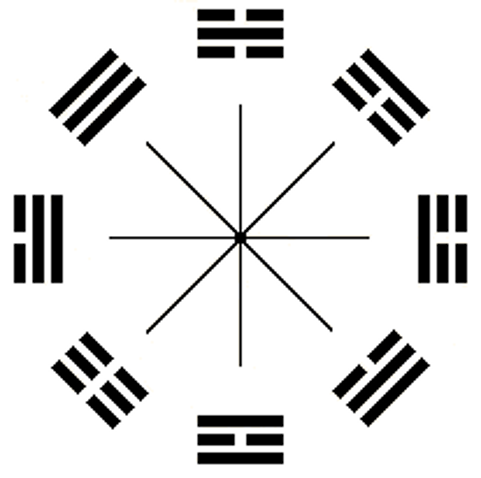
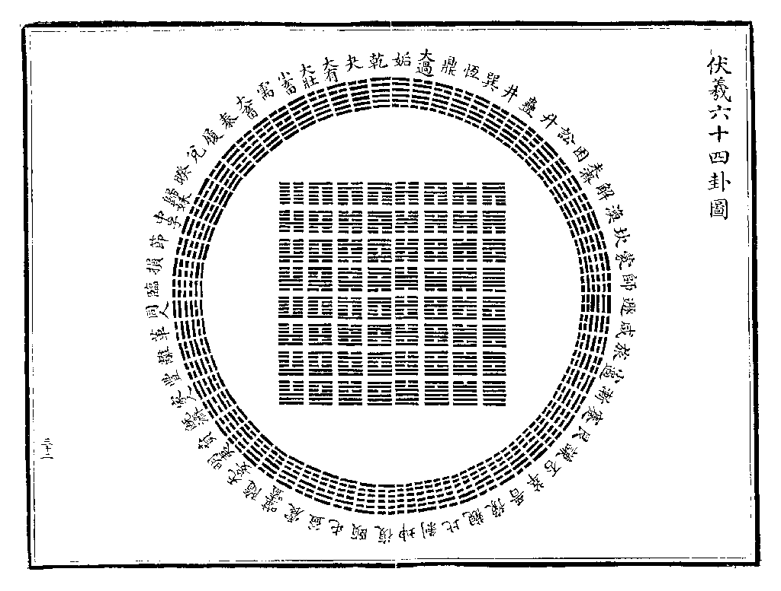
Allegedly developed by Fu Xi, the trigrams and hexagrams can be seen as coded messages from a supernatural power. In the Xici 繋辭 (The Attached Statements), one of the Ten Wings, we find a description of how Fu Xi developed a system of signs to represent the world.
When in early antiquity Pao Hsi [Fu Xi] ruled the world, he looked upward and contemplated the images in the heavens; he looked downward and contemplated the patterns on earth. He contemplated the markings of birds and beasts and the adaptations to the regions. He proceeded directly from himself and indirectly from objects. Thus he invented the eight trigrams in order to enter into connection with the virtues of the light of the gods and to regulate the conditions of all beings. (Wilhelm-Baynes, 1967, 328-329)
For the authors of Xici, the eight trigrams are man-made symbols. They are “signifiers” that help us, the perceivers, develop a sense of what the “signified” may look like. Hence, trigrams are not reality. But they present images of reality that allow us to function in the world. Take, for instance, the eight trigrams ( , , , , , , , ). With different combinations of a straight line (—), a yang cosmic force, and a broken line (‒ ‒), a yin cosmic force, a trigram symbolizes the cosmos’ constant renewal and its creation of the myriad things. Similarly, a hexagram is also a symbol of the unfolding of the universe. For example, a hexagram can be divided into two trigrams: the lower trigram (lines 1-3) and the upper trigram (lines 4-6). With one trigram below and one trigram above, a hexagram symbolizes the interaction of two sets of yin-yang configuration, demonstrating the multiple ways in which the yin and yang forces interact and transform each other. One may also take the lower two lines of a hexagram as representing the earth (di 地), the middle two lines as representing humankind (ren 人), and the top two lines as representing heaven (tian 天). Then, we have a trigram within a hexagram. Known as the “three potencies” (san cai 三才), the relation of heaven, earth, and humankind highlights the co-dependence between the natural realm (tian and di) and the human realm (ren).
In the quoted statement above, we find the first mention of tong 通. In the statement, we are told that Fu Xi created the eight trigrams to “enter into connection with the virtues of the light of the gods” (tong shenming zhide 通神明之德) (Wilhelm-Baynes 1967: 329). By “connecting with the virtues of the light of the gods,” the Xici authors mean a holistic understanding of the cosmos as dynamic, organic, and ever-changing driven by the forces produced by the myriad interlocking webs of relationships. Elsewhere, the authors of the Xici further explains this meaning of tong through the voice of Confucius:
The Master said: The Changes, what do they do? The Changes discloses things, complete affairs, and encompass all ways on earth—this and nothing else. For this reason the holy sages used them to penetrate all wills on earth and to determine all fields of action on earth, and to settle all doubts on earth. (Wilhelm/Baynes 1967: 316)
By “penetrating all wills on earth” (tong tianxia zhizhi 通天下之志), the authors of the Xici refer to developing a mental picture of the dynamic cosmos that is renewing and recreating itself every second.
In the above, we come across two meanings of tong in the Xici: to enter into a connection and to penetrate. While both meanings look more or less the same on the surface, there are subtle differences. Whereas “to enter into a connection” denotes an initiative to form a relationship, it is a situation where the initiator has an intention to establish a relationship, but there is no guarantee that the receivers will accept the initiative. The initiator is waiting for the signals of acceptance. In contrast, “to penetrate” describes a more forceful intervention into forming a relationship. The initiator is determined to break through the barrios to form a relationship. The receivers may reject the initiation, but the initiator is going to be resolute and resilient in forming a relationship.
Fear and Anxiety
However, how do we “to enter into connection with the virtues of the light of the gods” or “to penetrate all wills on earth” when we are always limited by our environment and constantly conditioned by our man-made structures? We may occasionally awake that the cosmos is dynamic and fluid (such as when taking a leisure walk in the park after work). But in our daily life, our time is compartmentalized, our schedule is regimented, and our mind is preoccupied with duties and obligations to our boss, our friends, and our family. Only when an unexpected incident occurs then we are awakened from the façade of certainty in the planned life-style. For this reason, the authors of the Xici identified the transition from the Shang dynasty to the Zhou dynasty—one of the most tumultuous periods in early China—as the starting point of the popularity of the Yijing divination. They write:
The Changes came into use in the period of middle antiquity. Those who composed the Changes had fear and anxiety. (Wilhelm/Baynes 1967: 345, with modification) [2]
Here, the Xici authors link the popularity of the rise of the Yijing to the momentous transition when the mandate of heaven (tianming 天命)—the power to rule China—was abruptly passed from the Shang family to the Zhou family during the 10th century BCD. To highlight the importance of divination in assuaging human fear, the authors of the Xici coin two terms—you 憂 (fear) and huan 患 (anxiety)—to describe the different states of human apprehension of uncertainty. To further clarify what fear and anxiety mean, the authors of the Xici write:
The time at which the Change came to the fore was that in which the house of Yin [Shang] came to an end and the way of the house of Zhou 周 was rising, that is, the time when King Wen and the tyrant Zhou 紂 were pitted against each other. This is why the hexagram statements of the book so frequently warn against danger. He who is conscious of danger creates peace for himself, he who takes things lightly creates his own downfall. (Wilhelm/Baynes 1967: 352-353, with modifications)
Directly linking the popularity of hexagram divination to the epic battle between the last ruler of Shang (King Zhou) and the first ruler of Zhou (King Wen), the authors of the Xici see hexagrams as stern warnings against danger and downfall. In these warnings, hexagrams provoked fear by reminding readers—typically, those involved in government—of the disastrous consequences of bad decisions and reckless moves (such as the tyrant Zhou’s brutality that led to the downfall of the Shang). They also instilled anxiety by calling attention to the vulnerability of human beings and the randomness in human fate (such as the sudden fall of the Shang and the unexpected rise of the Zhou). Whether provoking fear or instilling anxiety, the effect of divination is the same. It forces readers to reflect on their arrogance, complacency and self-indulgence. It shocks them to look for ways to come to terms with contingency and serendipity. Above all, it directs attention to the dark side of human existence such as disease, deformation, degeneration, and death (Redmond & Hon 2014: 128–139).
For the authors of the Xici, it did not matter whether danger and downfall happened in the political realm or in one’s body. The truth of the matter is that human beings have little control of their fate. At the same time, the authors of the Xici also sought to console nervous readers, assuring them that if they learnt to read hexagrams properly, they will discern the pattern behind incessant changes. They write:
The Changes is a book from which one may not hold aloof. Its dao [i.e., pattern] is forever changing—alternating, movement without rest, flowing through the six empty places [of a hexagram]; rising and sinking without fixed law, firm and yielding transform each other. They cannot be confined within a rule; it is only change that is at work here. They move inward and outward according to fixed rhythms. Without and within, they teach caution. They also show care and sorrow and their causes. Though you have no teacher, approach them as you would your parents. (Wilhelm/Baynes 1967: 348-349, with modifications)
Seen in this light, the 64 hexagrams are no longer oracles. They become symbols of the constant movements in the universe and the ceaseless changes in one’s life. More important, they point to the intricate networks of factors or forces—from near to us to far away, from simple to complicated, from visible to invisible—that shape movements and changes.
Take, for instance, Qian (The Creative #1). The line statements depict the six yang lines as a dragon in various positions—a “hidden dragon” in line one at the bottom, an “emerging dragon” in line two, a “wavering dragon” in line four, a “flying dragon” in line five, and an “arrogant dragon” in line six at the top. In addition, the line statements suggest a correspondence between the dragon’s position and a proper course of action: the “hidden dragon” should avoid taking aggressive action, the “emerging dragon” and the “flying dragon” should seek help from “a great man”, the “wavering dragon” should take flight over the depths despite the danger and apparent risks, and the “arrogant dragon” will regret being stubborn and excessively confident. But, as a hexagram, Qian is ambiguous. On the one hand, in five of its six lines, the tone seems to be upbeat, projecting an impression of an incessant progress from a hidden dragon to an emerging dragon, a wavering dragon and finally a flying dragon. On the other hand, the progression is abruptly cut short by the downfall of an arrogant dragon. Like a Greek tragedy, the rapid fall of the arrogant dragon suggests hubris, highlighting the danger of excessive human pride in making strenuous efforts to pull oneself up.
To Resonate Actively or Passively
With this realization, human beings are no longer fearful of uncertainty and unpredictability because they are essential parts of the dynamic and ever-changing cosmos. Here, we reach the third meaning of tong: to reach an understanding of who we are as human beings. As human beings, we know that we are both subject and object. We are subject when we take action to change our present condition. But our action is conditioned by the environment. Hence, we must be an object first before we can be a subject, and our action in turn produces a new environment in which we are an object. This constant overlapping of subjectivity and objectivity renders the distinction between a subject and an object almost meaningless, because being a subject or an object only refers to the moment when one is interacting with the environment. For this reason, whether passively “to enter into connection with the virtues of the light of the gods” or aggressively “to penetrate all wills on earth,” we face the same reality that we are both an initiator and a receiver in the unfolding of the universe. We look powerful and successful in forging a relationship when the circumstances allow us; we look powerless and unsuccessful in forging a relationship when the circumstances are not favorable. Here, tong means that we reach an understanding of our fate as subject and object in the dynamic and entangled world.
Nevertheless, the authors of the Xici think that a distinction between a subject and an object is still necessary to show the direction of making a change—whether a change occurs after a player actively pushes for it, or whether a change happens where a player is forced to take action. To denote the former, i.e., a player who actively creates a change by taking an action, the authors of the Xici uses the term (tongbian 通變, literally, a change takes place after a relationship has been formed). To explain tongbian, the authors of the Xici writes:
Therefore the superior man, whenever he has to make or do something, consults the Changes, and he does so in words. It takes up his communications like an echo; neither far nor near, neither dark and deep exist for it, and thus he learns of the things of the future. If this book were not the most spiritual thing on earth, how could it do this?
The three and five operations are undertaken in order to obtain a change. Divisions and combinations of the numbers are made. If one proceeds through the changes, they complete the forms of heaven and earth. If the number of changes is increased to the utmost, they determine all images on earth. If this were not the most changing thing on earth, how could it do this? (Wilhelm/Baynes 1967: 314)
Here, the authors of the Xici focuses on “proceeding through the changes” (tong qi bian 通其變)—the active role that we, as humans, create connections and thereby contribute to the continuous movement of the cosmos. In this situation, the impetus comes from our willingness to “proceed,” namely, following the flow that has built up previously, and completing the trend that has already set in motion. This willingness to “proceed” is based on a cognitive recognition of the growing trend and a timely intervention into the flow of events to make things happen.
For this reason, the authors of the Xici put premium on “proceeding through the changes.” Elsewhere, they elevate it as one of the key characteristics of the Yijing. They write,
It [the Yijing] possesses everything in complete abundance: this is its great field of action. It renews everything daily: this is its glorious power. As begetter of all begetting, it is called change. As that which completes the primal images, it is called the Creative; as that which imitates them, it called the Receptive. In that it serves for exploring the laws of number and thus for knowing the future, it is called revelation. In that it serves to infuse an organic coherence into the change, it is called the work. That aspect of it which cannot be fathomed in terms of the light and the dark is called spirit. (Wilhelm/Baynes 1967: 299-301)
By “infusing an organic coherence into the change” (tongbian 通變), the authors describe how the cosmos continues to unfold when human beings actively make connections in their own circles. The active role that human beings play is foregrounded by putting tong (making connection) ahead of bian (change), highlighting the fact that the change happens because human beings take the initiative in making connection.
But there are situations where human beings are on the receiving end. In this situation, they do not take the active role in making connection. On the contrary, the change has taken place that forces them to go along. The authors of the Xici call this situation biantong 變通, literally a connection is made because of a change has taken place. The authors of the Xici write,
The Master said: Writing cannot express words completely. Words cannot express thoughts completely. Are we then unable to see the thoughts of the holy sages?
The Master said: The holy sages set up the images in order to express their thoughts completely; they devised the hexagrams in order to express the true and the false completely. Then they appended judgments and so could express their words completely. They made changes and connections to show the advantage completely; they urged on, they set in motion, to set forth the spirit completely. (Wilhelm/Baynes 1967: 322)
By “making changes and connections to show the advantage completely” (bianer tongzhi yijinli 變而通之以盡利), the authors of the Xici focus attention on changes that occur as the result of connecting the dots or building the web of relations. Here, unlike in other occasions, the authors of the Xici purposedly put bian 變 (change) in front of tong 通(connection) to highlight the different dynamic of forces. Whereas in other occasions human beings are the active players in initiating the changes, here it is the changed situation that forces human beings to respond. In the end, human beings do make new connections and weave a new web of relations. But they are the object rather than the subject. It is the altered situation (bian) that force them to take action to create a new connection (tong).
Conclusion
In the broad picture of the self-transformation of the cosmos, it makes no difference between biantong or tongbian. It does not matter whether human beings are active or passive, as long as they dance along with the dynamic tune of the cosmos’ self-transformation. Inasmuch as human beings are participating in the unfolding of the cosmos in their daily life, it is fine if they are active passive, or passive active. For us who encounter fear and anxiety every day, the key point about tongbian or biantong is to immerse into the cosmic flow of change and transformation. We remember that when we feel vulnerable and fragile, it is an occasion where we are reminded of the confluence of factors that shape our lives. But as we are swept along by the current, we should find our position, our rhythm, our trajectory. In the end, the key point is not when and how we enter the great flow of the universe, but what we become and what we achieve after we join the great flow.
References
Cheng, Chung-ying, 2020. The Primary Way: Philosophy of Yijing. Albany: State University of New York Press.
Gotshalk, Richard, 1999. Divination, Order, and the Zhouyi. Lanham, MD: University Press of America.
Hon, Tze-ki, 2019. “The Chinese Philosophy of Change (Yijing),” Stanford Encyclopedia of Philosophy (May 29, 2019). (https://plato.stanford.edu/entries/chinese-change/)
Nylan, Michael, 2001. The Five “Confucian” Classics. New Haven: Yale University Press.
Redmond, Geoffrey and Tze-ki Hon, 2014, Teaching the I Ching (Book of Changes). Oxford: Oxford University Press.
Shaughnessy, Edward L. 2014. Unearthing the Changes: Recently Discovered Manuscripts of the Yijing (I Ching) and Related Texts. New York: Columbia University Press.
_____. 2022. The Origin and Early Development of the Zhou Changes, Leiden: Brill.
Smith, Richard J., 2008, Fathoming the Cosmos and Ordering the World: The Yijing (I-Ching, or Classic of Changes) and Its Evolution in China. Charlottesville, VA: University of Virginia Press.
–––, 2012, The I Ching: A Biography. Princeton, NJ: Princeton University Press.
Tillich, Paul, 2000. Courage to Be. New Haven: Yale University Press
Wilhelm, Richard, and Baynes, Cary F., 1967, The I Ching or Book of Changes. Princeton: Princeton University Press
Tze-ki Hon teaches at Beijing Normal-Hong Kong Baptist University. Before he relocated to Zhuhai, he had taught at City University of Hong Kong, State University of New York at Geneseo, and Hanover College, Indiana. Over the last three decades, he wrote four books: The Yijing and Chinese Politics (2005), The Allure of the Nation (2013), Teaching the I Ching (Book of Changes) (with Geoffrey Redmond, 2014), and Revolution as Restoration (2014). He edited seven volumes: The Politics of Historical Production in Late Qing and Republican China (2007), Beyond the May 4th Paradigm (2008), The Decade of the Great War (2014), Confucianism for the Contemporary World (2017), Cold War Cities (2022), The Other Yijing (2022), The Cityscapes of Taipei, Hong Kong, and Singapore during the Cold War (2025), and Contemporary Interpretations and Readings of the Yijing (2025). His articles have appeared in Journal of Chinese Philosophy, Modern China, Monumenta Serica, and Sungkyun Journal of East Asian Studies.
[1] The Ten Wings are: (1-2) Tuanzhuan 彖傳 (Commentary to the Judgments); (3-4) Xiangzhuan 象傳 (Commentary to the Images); (5) Wenyan 文言 (Words of the Text); (6-7) Xici 繫辭 (Appended Statements, also known as Dazhuan 大傳, [The Great Treatise]); 8: Shuogua 說卦 (Explanation of the Trigrams); (9) Xugua 序卦 (Hexagrams in Sequence); (10) Zagua 雜卦 (Hexagrams in Irregular Order).
[2] In Wilhelm/Baynes translation, you and huan are rendered respectively as “care” and “sorrow.” While this rendition is acceptable, it does not convey the psychological difference in you as perceiving a tangible threat and huan as anticipating an invisible impending danger. For me, the more accurate translation of you and huan is using Søren Kierkegaard’s distinction between fear (of a visible object) and anxiety (of an impending danger). See Kiekegaard and Paul Tillich.
Comment to the article: “To Resonate with the Ever-Changing World: The Concept of Tong 通 in the Xici 繫辭 of the Yijing.”
Bjoern Aage C. Blix, Post Doctoral Researcher, School of Foreign Languages, Hunan University, Changsha, China
This is an elegant and ambitious essay. It argues that tong 通, as used in the Xici 繫辭, names the process by which the text responds to fear and anxiety: the shock of an unexpected event, the collapse of habitual routines, and the re-engagement with a world perceived as dynamic and open. The essay’s contribution is to bring the Xici into conversation with contemporary existential concerns without reducing the text to edifying quotations, and to offer a genuinely original reading of the tongbian/biantong distinction. The topic deserves attention, and the comments below are offered in the spirit of strengthening an essay that is already doing important work.
The central argument rests on three meanings of tong: “to enter into connection (通神明之德, Xici II.2),” “to penetrate (通天下之志, Xici I.11),” and “to reach an understanding of who we are as human beings.” The first two are purpose phrases in which tong is a verb of action. The construction is yi以 tong通 X where yi introduces the purpose of the preceding action (making the trigrams, using the Yijing), and tong is the verb. In these two passages, the Xici is telling us what the sages do with the text. The third meaning, by contrast, is constructed through a discussion of tongbian 通變 and biantong 變通, based on the passages 通其變 (Xici I.10), 通變之謂事 (Xici I.5), and 變而通之以盡利 (Xici I.12). This raises a question about the status of the third meaning: is it a meaning of tong itself, or a meaning of tong in combination with bian? The question becomes sharper when we look at the visible form of the passages. One basis for tongbian is 通其變, which has the character qi其 in the middle; another is 通變, which appears in Xici I.5—but there, 通變之謂事 seems to be a definition of shi 事, not a definition of tong or of tongbian. Biantong, on the other hand, is based on 變而通之以盡利, which has the character er而 in the middle: the compound 變通 does not appear in the passage, but what appears is a verbal phrase with a conjunction (變而通之). This matters for the essay’s central claim, because the claim that tongbian and biantong are two directions of tong depends on both being terms the Xici uses. If biantong is a term the essay constructs from 變而通之, rather than a compound the Xici itself uses, then the essay should say so, and the claim that tong has three meanings should be qualified: Either tong has three meanings where the addition of bian enables a third meaning to the term, or tong has two meanings as a standalone term with a third dimension that emerges when it is combined with bian. Making this explicit would sharpen the essay’s central claim and make its originality more visible. It would also clarify the conclusion’s focus on tongbian and biantong as it currently does not return to the other two standalone meanings.
This question about the compound terms is sharpened by a second consideration: the introduction and treatment of bian itself. The essay’s reading of tongbian and biantong turns on the order of the characters, treating bian as the element that indicates the direction of the connection. But bian appears in the essay rather suddenly, without an argument for why bian—rather than another term—is the one paired with tong. The essay does not consider whether tong appears in other compounds in the Xici, or why bian is the relevant counterpart. If tong is paired with other terms elsewhere, then the choice of bian needs to be justified; if it is not, the essay should emphasize this unique pairing. Nielsen describes bian as “one of several terms used in The Changes to denote the opposite of permanence,” alongside hua 化, yi 易, dong 動, and tong 通 itself, and as “the alternation between ‘bipolar opposites’” (2003, 19). Rutt defines bian as “alternation” and explains it as “bipolar change from positive to negative and vice versa,” and defines tong as “an expanded series of bipolar alternations (bian)” (2002, 407). Based on these definitions, tong and bian may be nested rather than coordinate (bian as the single alternation, tong as the series). The essay’s reading of the order of the characters would benefit from an explicit account of how the two terms relate, and from an early introduction of bian—perhaps where the essay introduces the changing interaction of yin and yang—so that its appearance in the final section is less sudden.
Early in the essay the reader is introduced to spontaneity and openness as qualities we trade off in everyday life, “we trade off spontaneity and openness to focus our full attention on matters dearest to us” (L. 11). This comes across as important to the essay’s argument, and it motivates the essay’s turn to tong. But these terms do not reappear in the discussion of tong, tongbian, or biantong. If tong is the process by which we recover spontaneity and openness, the essay might benefit from returning to those terms throughout and in the conclusion. As it stands, the essay introduces the qualities we lose but does not return to them as the qualities we gain through tong; making that connection explicit would give the essay’s argument more coherence.
The essay repeatedly cites Wilhelm-Baynes “with modifications,” but the nature and extent of the modifications are not specified. For an argument that depends on precise readings of tong and related terms, this is a significant gap—the reader cannot tell whether the modifications are minor or substantive. The rendering of shenming zhi de 神明之德 as “the light of the gods” is a case in point as it is cited one time and repeated four times after throughout the essay. Is preserving the Wilhelm-Baynes Christianization of Yijing’s philosophy a deliberation of the author? Given the statements about “modifications” and that the author reads classical Chinese, as well as is one of the leading interpreters of the Yijing in English, it would strengthen the essay to cite the Chinese text directly and offer his own English rendering. If it is deliberate to preserve the Christianization of Yijing, and his own rendering happens to be close to the Wilhelm-Baynes, a mention of it in a footnote would be better to foreground his own close reading. This is not a rejection of Wilhelm-Baynes—it remains a valuable resource—but a question about how the author’s interpretation is made visible to the reader.
The essay uses “world,” “universe,” and “cosmos” somewhat interchangeably. Consider reserving one term for the habitual, human-centered frame and another for the cosmic process to help the reader follow the conceptual shifts. Some minor things were picked up during the reading: the essay uses (Wilhelm-Baynes) and (Wilhelm/Baynes), (Redmond-Hon) and (Redmond & Hon), Kirkegaard is mentioned in footnote two but not listed in the reference list, and there are three different translations of Xici (“Attached Verbalizations,” “Appended Statements,” and “The Attached Statements”). Standardizing these would make the essay’s citations and terminology more consistent.
These comments are offered in a spirit of admiration for the essay’s achievement. The distinction between tongbian and biantong is a real contribution to the field, and the essay’s phenomenological framing makes the Xici newly available to readers who might otherwise find it remote. As a final comment, I want to praise the author’s consistent use of musical terms (resonate, attune, tone, rhythm, upbeat, dance along, dynamic tune) throughout the article—it gives it a layered coherence that is rare.
References
Nielsen, Bent. 2003. A Companion to Yi Jing Numerology and Cosmology. RoutledgeCurzon.
Rutt, Richard. 2002. The Book of Changes (Zhouyi). Routledge.
Comment on the Prepublished Article by Tze-ki Hon “To Resonate with the Ever-Changing World: The Concept of Tong 通in the Xici 繫辭of the Yijing”
Hoey Ho-ting Chan, Chinese University of Hong Kong
Tze-ki Hon’s “To Resonate with the Ever-Changing World: The Concept of Tong 通in the Xici 繫辭of the Yijing” is a mediation on self and cosmos through the thorough explanation of the concept of Tong in the Xici of the Yijing in the post-pandemic era. The world has been struggling to recover from and reform in this plague and resulted in new economic patterns, shifts in social connectedness, and changes in everyday behavior. Even the emergence of artificial intelligence cannot shield us from the uncertainty through the statistical analysis on historical data to forecast future events. Hon’s principle contribution is to divulge the concept of Tong in Xici so as to let the reader understand the uncertainty and unpredictability in the universe and how should we position ourselves in this ever-changing yet intertwined world even we are trapped in rut by the repetitive and monotonous routines in our daily lives.
Hon closely examines the Yijing’s composition and philosophical depth. He first introduces three sages that allegedly composed the classic, Fu Xi 伏羲for the eight trigrams and sixty four hexagram, Later, the Seven Writings expanded the scope of the book, resulting in the Ten Wings. As a result, the Yijing came to encompass not only images (xiang 象), but also statements (ci 辭), numbers (shu 數), and principles (li 理). Hon then provides the core practice of Yijing, divination, to explain how the upper class society in Ancient China decoding the lines and hexagrams to make important decision based on their past experience, presentiment and foresight through the acceptance of human’s limitation in the dynamic world when the broken and unbroken lines representing the forces of Yinyang indicating the unending creation of the universe, interacting with one another as the upper trigram and lower trigram and revealing the relations with the natural realm and human realm.
Hon does not continue the scholarly discussion of the literal meaning of the words of Bian and Tong, instead, he makes use of the Wilhelm-Baynes translation of The Book of Changes, which is also the most influential Western translation, and it helps to add a burst of psychological colour to the academic discussion. Indeed, beyond its historical context and literary meaning, Hon also situates his study of tong within a psychological framework. He first discusses the meaning of Tong in “enter into connection with the virtues of the light of the gods” (tong shenming zhide 通神明之德) portraying the dynamic world shaped by countless interlocking relationships, yet powered by non-forceful energy, while “penetrating all wills under heaven” (tong tianxia zhi zhi 通天下之志) reveals forceful renewal in that dynamic world. Therefore, through the case of King Wen and the tyrant Zhou in Xici, Hon believes the hexagrams symbolize the relentless movement in the universe and the state of flux in life. By reflecting the darker dimensions of human existence, fear, anxiety, and the physical vulnerability of life, Hon reveals the third layer of tong and enable an understanding of who we are as human beings. This understanding is achieved by “proceeding through the changes” (tong qi bian 通其變) ,“infusing an organic coherence into the change” (tongbian 通變) and “making changes and connections to show the advantage completely” (bianer tongzhi yijinli 變而通之以盡利). Which means one could act as water and follow the flow or actively establish connection before the change, or be compelled to connect as a result of change. It provides a deeper understanding of the discussion of change and the ability to keep within the flow of change .
After performing a close textual analysis and giving philological attention to key terms, Hon contextualizes the concept of biantong (變通) within modern perspectives. He may also adopt a comparative approach, drawing on discussions by both Western and Eastern scholars to further reveal how human fear and anxiety have persisted across time and space. Such a comparison could illuminate differing understandings of cosmology and demonstrate the continuing value of The Book of Changes in the fields of psychology, ecology, and astronomy.
In this understanding, we recognize that identity is not fixed or self-contained, but continually formed through change, relationships, and our responses to circumstances beyond our control. To be human, in this sense, is to live within flux while seeking coherence, meaning, and possibility amid it. An understanding of the philosophy of The Book of Changes provides insight into the foundations of Chinese culture, shedding light on human behavior, the relationship between the self and the environment, and the patterns that govern the cosmos. Hon’s writing shows his contemporary relevance amid the human crisis and it is indeed a rare treasure in the shadow of recession.