
François Prouteau
Humanities Director – Catholic University of Lille
Introduction
The scene unfolds in Antarctica under the watchful gaze of Claude Lorius, one of the pioneers of Anthropocene science (Prouteau, 2026). Having participated in nearly twenty scientific expeditions since 1957, working in temperatures approaching –50°C across the immense white continent—larger than Europe itself—he contemplates one last time the visible consequences of global warming. Vast icebergs are breaking away from Antarctic glaciers with increasing frequency and magnitude, a process that accelerates as global temperatures continue to rise. Under a global warming scenario of between 1.5°C and 2°C, several tipping points could be triggered, including the collapse of the West Antarctic Ice Sheet, the melting of Greenland’s ice sheet, the disappearance of coral reefs in low-latitude regions, and the large-scale, rapid thawing of permafrost.
Confronted with the spectacle of a world suspended between persistence and collapse, Claude Lorius nevertheless continued to hope for a collective awakening capable of giving rise to a more desirable future—what Edgar Morin, in a January 2010 article published in Le Monde entitled “In Praise of Metamorphosis,” called a metamorphosis. Lorius frequently invoked one of Morin’s most striking formulations: “The probable outcome is disintegration. The improbable, yet possible, outcome is metamorphosis.”
Morin, E. (2010). Éloge de la métamorphose. Le Monde, January 9, 2010.
This observation was subsequently revisited and discussed by Claude Lorius and Laurent Carpentier in their 2010 book Voyage en Anthropocene. They reflected on the possibility that humanity, through an increasing awareness of the Anthropocene, might fundamentally transform its behaviors, institutions, and systems of governance—ceasing to act as the gravedigger of the Earth and becoming instead its steward and guardian.
The obstacles to such desirable metamorphoses remain considerable in 2026. They include persistent forms of resistance aimed at discrediting scientific knowledge, ranging from climate-skeptic lobbying to the defense of sectoral economic interests embedded within structures of financial power and reinforced by a broader ideology of technological hubris. As climatologist Valérie Masson-Delmotte (2026), whose work as Vice-Chair of the Intergovernmental Panel on Climate Change (IPCC) follows in the footsteps of glaciologists Claude Lorius, Jean Jouzel, and other paleoclimatologists, has observed:
“The fact that humanity is unintentionally altering the climate through greenhouse-gas emissions is scientifically established. Yet this reality is unsettling because it points to future risks for ecosystems and human development; because it is difficult to acknowledge our own responsibilities; because responding to it requires environmental regulations often perceived as restrictive; because market economies prove inadequate for addressing the phenomenon; and because recognizing it may lead to the devaluation of financial assets, notably investments in the fossil-fuel sector or in real estate located in areas exposed to coastal inundation.”
The Anthropocene thus confronts humanity not only with a planetary environmental crisis, but also with a crisis of knowledge, responsibility, and collective imagination. Whether the future will be shaped by disintegration or by metamorphosis remains an open question, one whose answer increasingly depends on our capacity to rethink the relationships between science, society, governance, and the Earth system.
It is precisely these desirable metamorphoses that the present paper seeks to explore.
1. From Antarctic Ice Cores to Earth System Thinking: The Anthropocene as an Epistemological Rupture
Claude Lorius and his teams of glaciologists profoundly transformed our understanding of climate dynamics across deep time and contributed to the emergence of the concept of the Anthropocene, which entered scientific discourse through the influential work of scholars such as Paul Crutzen at the turn of the twenty-first century. Far from being a speculative narrative, the Anthropocene emerged from decades of cumulative interdisciplinary research that revealed the unprecedented scale of human influence on planetary processes.
A decisive breakthrough came from the Antarctic ice-drilling programs conducted at Vostok Station. Initiated with drilling campaigns in the early 1980s and culminating in the 1998 ice core reaching a depth of 3,603 meters, these investigations made it possible to reconstruct atmospheric and climatic variations over the preceding 420,000 years.
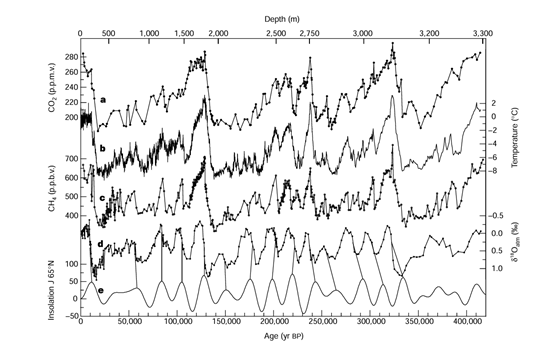
These records demonstrated that atmospheric greenhouse-gas concentrations had remained relatively stable throughout successive glacial and interglacial cycles prior to industrialization, fluctuating between approximately 180 and 300 parts per million (ppm) of carbon dioxide. They also established a robust correlation between greenhouse-gas concentrations and variations in global temperature.
The findings were consistent with the conclusions of the landmark Charney Report published in 1979 by the U.S. National Academy of Sciences. That report estimated that a doubling of atmospheric carbon dioxide would likely result in approximately 3°C of warming, within a range of 1.5°C to 4.5°C. Subsequent assessments by the Intergovernmental Panel on Climate Change (IPCC) have reinforced these conclusions, establishing with a very high degree of confidence that human activities constitute the dominant driver of contemporary climate change.
The methodological contribution of Antarctic glaciology was equally significant. Claude Lorius and his colleagues (Raynaud et al., 1993) demonstrated that climate knowledge does not emerge from isolated discoveries but from cumulative interdisciplinary inquiry. Their work further revealed that the climate system is a complex and open system governed by radiative forcing and shaped by multiple feedback mechanisms. It cannot be understood through simple linear chains of causality. Rather, it exhibits the nonlinear behavior characteristic of complex systems, in which feedbacks may amplify or dampen change and where thresholds and tipping points become essential features of system dynamics.
In the same journal issue that published the seminal article “The Anthropocene” by Crutzen and Stoermer (2000)—whose intellectual origins Fabien helpfully recalled during the organization of this symposium—Will Steffen drew explicitly upon the Vostok data to situate contemporary environmental transformations within the broader framework of Earth system dynamics. Reflecting on the lessons of the ice cores, Steffen observed:
“No record is more fascinating than the rhythmic ‘breathing’ of the planet, as revealed by the temperature series and the CO₂ and CH₄ records extracted from the Vostok ice cores (Petit et al., 1999) … The current atmospheric CO₂ concentration of 365 ppmV lies far beyond the upper limit observed in recent Earth history; there is no evidence for a stable state or ‘domain of attraction’ beyond approximately 280 ppmV … From the perspective of the Earth’s metabolism, we are now navigating toward a terra incognita. More than ever, we must build a truly integrated and interdisciplinary Earth system science capable of understanding the evolution of our planet and our role within it.” (Steffen, 2000)
With the benefit of greater historical perspective, Steffen and his colleagues would later write:
“It is no coincidence that the proposal of an Anthropocene Epoch emerged from the Earth system science community … For the first time, a major shift in the state of the Earth system was proposed on the basis of direct observations of Earth system change, without specific reference to evidence from the stratigraphic record.” (Steffen et al., 2016)
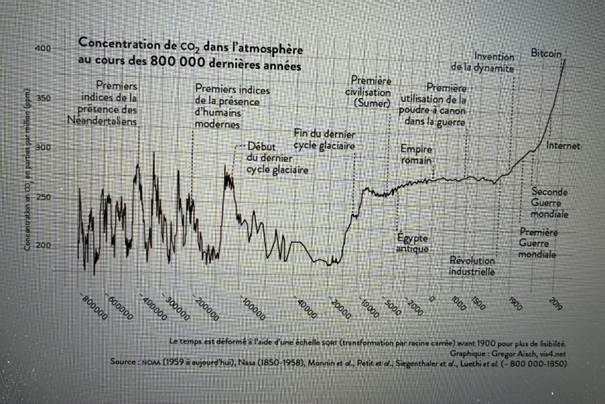
Furthermore, “despite the abrupt climatic fluctuations of the Quaternary, the biosphere did not undergo any significant long-term changes during that period” (Steffen et al., 2016), whereas one of the indicators of the Anthropocene observable today is the disruption of the biosphere.
Within this context, the Anthropocene appears as a genuine rupture. Human activities have driven atmospheric concentrations well beyond the boundaries that characterized past climates. As Lorius and Carpentier forcefully observed:
“In scarcely two centuries, humanity had transformed the Earth in ways that neither volcanoes, asteroids, nor the Earth’s orbit around the Sun had done for millions of years. This brief period was sufficiently singular and radical to constitute an unprecedented epoch in the geological history of the planet.” (Lorius & Carpentier, 2010, p. 63)
The Anthropocene is therefore more than a geological designation; it represents an epistemological transformation. It calls for a new mode of inquiry capable of integrating geology, climatology, ecology, sociology, economics, and the humanities. It confirms the necessity of interdisciplinary and systemic approaches for understanding planetary change. As the Earth system enters a domain increasingly characterized by tipping points, nonlinear dynamics, and profound uncertainties, the Anthropocene challenges inherited modes of knowledge and calls for the emergence of a genuinely integrated science of Earth and humanity.
The question posed by Lorius and Carpentier remains strikingly relevant today:
“Could it be that we leave the Anthropocene before we even realize that we have entered it?” (Lorius & Carpentier, 2010, pp. 144–145)
In response, Lorius and Carpentier, following Edgar Morin, called for a metamorphosis capable of preventing humanity from descending into total collapse.
2. Sustainability and Metamorphosis in the Anthropocene
2.1 The Properties of Metamorphosis in Edgar Morin’s Thought
In his article In Praise of Metamorphosis, Edgar Morin identifies a set of characteristics that distinguish metamorphosis from other forms of change, such as transition, revolution, partial reform, simple adaptation, or disintegration.
First, metamorphosis gives rise to a meta-system capable of addressing vital problems that the former system can no longer resolve. Second, it entails radical transformation while preserving a fundamental continuity of identity. Third, change proceeds through a process of internal deconstruction followed by organized reconstruction, much as a caterpillar becomes a butterfly through a simultaneous process of self-destruction and self-reconstruction. Fourth, metamorphosis remains possible without being probable. As Lorius and Carpentier reiterate in Voyage in the Anthropocene, “the probable outcome is disintegration; the improbable yet possible outcome is metamorphosis.” Finally, metamorphosis emerges from modest and dispersed beginnings that gradually connect and develop into networks.
The fundamental property of metamorphosis in Morin’s work may therefore be summarized as follows:
Metamorphosis is an improbable yet possible process through which a system in crisis generates a meta-system endowed with new qualities, through a process of self-reconstruction that radically transforms its form while preserving its essential identity and inherited legacies.
This conception situates transformation neither within the logic of linear progress nor within that of inevitable collapse. Rather, it emphasizes emergence, creativity, and the capacity of complex systems to reorganize themselves under conditions of crisis.
2.2 Rethinking Sustainability Through Metamorphosis—and Beyond
To what extent does metamorphosis provide a particularly fruitful framework for rethinking sustainability in the Anthropocene?
Unlike approaches centered on adaptation, optimization, or incremental adjustment, metamorphosis designates a process through which a system in crisis generates a meta-system capable of addressing vital challenges that the previous order could no longer manage. Sustainability thus appears less as a matter of institutional fine-tuning than as a process of meta-organizational transformation.
This dynamic rests upon several key attributes. The first is the articulation between conservation and transformation. Metamorphosis preserves biological, cultural, and social inheritances while simultaneously generating new organizational forms. The second is a process of self-destruction and self-reconstruction, through which structures that have become inadequate are reorganized under the pressure of crisis. The third concerns the emergence of new qualities irreducible to pre-existing elements, opening pathways toward novel ways of inhabiting the Earth.
Morin also emphasizes the “improbable yet possible” character of metamorphosis, rejecting both the fatalism of collapse and the illusion of automatic progress. Metamorphosis does not result from historical necessity; rather, it emerges through contingent processes of recomposition and innovation.
Finally, metamorphosis unfolds through the convergence of marginal initiatives and through a dialogical mode of thought capable of articulating apparently contradictory polarities—growth and degrowth, globalization and deglobalization, autonomy and interdependence. Sustainability thereby becomes less a final state to be achieved than an emergent process of socio-ecological reconfiguration grounded in complexity, interconnectedness, and collective creativity.
Viewed in this way, sustainability is not merely a matter of maintaining existing systems; it becomes a question of fostering conditions under which new forms of social and ecological organization may emerge.
2.3 A Critical Analysis of Metamorphosis: Ethical, Epistemological, and Anthropological Perspectives
To what extent does In Praise of Metamorphosis reflect the broader intellectual legacy of Edgar Morin?
Morin rejects the paradigm of simplification in favor of a method capable of reconnecting what modern thought has tended to separate. In In Praise of Metamorphosis, social, ecological, political, and cultural crises are not treated as isolated phenomena but as interconnected dimensions of a broader global polycrisis.
This holistic perspective directly reflects Morin’s paradigm of complexity and his enduring effort to “re-weave” fragmented forms of knowledge. Climate disruption, biodiversity loss, technological acceleration, cultural fragmentation, and political instability together constitute a complex polycrisis whose dynamics emerge from interactions among ecological, social, economic, symbolic, and cognitive systems. In this sense, the concept of metamorphosis resonates strongly with contemporary calls for transdisciplinarity, Earth system thinking, and integral ecology.
Yet significant limitations remain.
Metamorphosis functions more effectively as a heuristic device and ethical horizon than as a fully developed epistemological paradigm. It provides neither a precise methodological apparatus nor clearly defined criteria for validation, prediction, or empirical verification. Its vocabulary often remains highly abstract, invoking notions such as emergence, complexity, or planetary consciousness that are difficult to operationalize within scientific practice.
Moreover, the concept of metamorphosis risks introducing a teleological expectation according to which crises necessarily generate positive transformations. The trajectories of the Anthropocene, however, may lead not to regeneration but to fragmentation, collapse, or authoritarian forms of adaptation. The future remains radically contingent.
As a thinker concerned with the destiny of humanity, Morin does not seek to predict the future; rather, he interrogates it through the fractures and vulnerabilities of the present. This orientation helps explain the continual evolution of his thought. Throughout his intellectual trajectory, each new formulation of metamorphosis emerged in response to an objective historical crisis—the Cold War, the ecological challenge, globalization, or the transformations associated with the digital age (IFRN, 2026).
Morin thereby demonstrates that the thinker, too, must undergo transformation. The stakes are therefore not merely epistemological; they are also anthropological. They point toward the possibility of a regenerated humanism—a notion that Morin himself has repeatedly invoked and defended throughout his work.
From this perspective, metamorphosis should be understood not as a predictive theory of history but as a conceptual framework for thinking about the conditions under which humanity might respond creatively to systemic crisis. Its value lies less in forecasting the future than in expanding the range of futures that remain imaginable.
3. Interpreting the Anthropocene Through Edgar Morin’s Concept of Metamorphosis
3.1 Perspectives on the Anthropocene
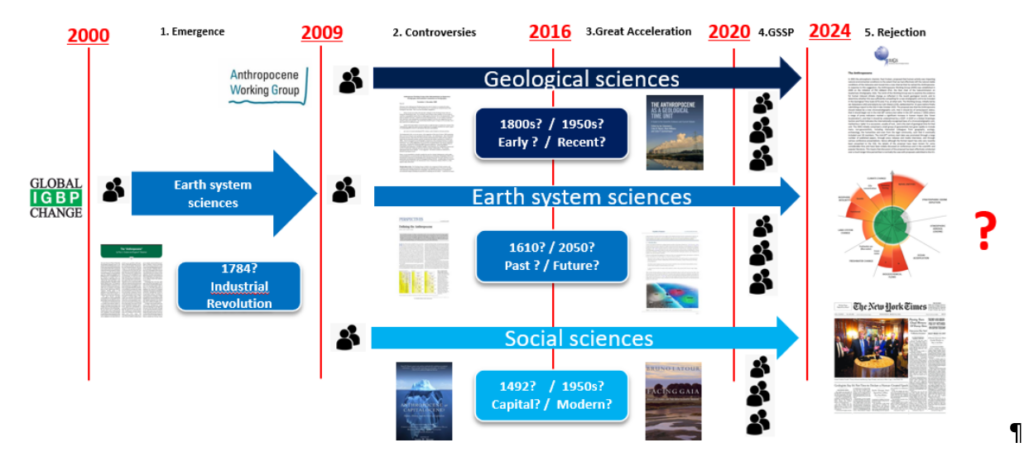
Drawing on the diverse perspectives that have emerged within geological sciences, Earth system science, and the social sciences and humanities, to what extent does Edgar Morin’s concept of metamorphosis provide a useful framework for understanding the major sustainability challenges of the Anthropocene from an interdisciplinary perspective?
Copyright/Fabien Colombo
The Anthropocene has generated a remarkable diversity of interpretations across disciplines. For some scholars, it primarily designates a new geological epoch characterized by stratigraphic markers of human activity. For others, it refers to a profound transformation of the Earth system, while still others emphasize its social, political, ethical, and cultural dimensions. These perspectives differ in their objects of analysis, methods, and normative implications, yet they converge around a common recognition: humanity has become a planetary force capable of altering the conditions of life on Earth.
Morin’s concept of metamorphosis offers a valuable lens through which to compare these approaches. It allows us to move beyond the mere diagnosis of environmental disruption and toward a broader reflection on the transformative capacities of human societies in the face of planetary crisis.
3.2 The Metamorphoses of the Anthropocene: A Comparative Reading
Geological Sciences: The Metamorphosis of the Earth System
From a geological perspective, the Anthropocene may be understood as a major stratigraphic and geological transformation, as illustrated by the work of Head et al. (2023).
Head, M. J., Zalasiewicz, J. A., Waters, C. N., Turner, S. D., Williams, M., Barnosky, A. D., Steffen, W., Wagreich, M., Haff, P. K., Syvitski, J., Leinfelder, R., McCarthy, F. M. G., Rose, N. L., Wing, S. L., An, Z., Cearreta, A., Cundy, A. B., Fairchild, I. J., Han, Y., Sul, J. A. I. do, Jeandel, C., McNeill, J. R., & Summerhayes, C. P. (2023). The Anthropocene is a prospective epoch/series, not a geological event. Episodes, 46, 229–238.
The authors argue that “the Earth system no longer operates within the envelope of Holocene variability” and that human activities have “driven the Earth system beyond Holocene conditions toward an as yet undetermined future state.” Humanity thus emerges as a “dominant geological force,” generating changes that are “geologically persistent.”
This interpretation mobilizes several attributes associated with metamorphosis: a shift in systemic regime, multidimensional transformation, the emergence of a new systemic condition, and the coexistence of continuity and rupture. Yet it remains largely descriptive. Dimensions such as reflexivity, self-reconstruction, and the emergence of alternative societal trajectories remain absent. The Anthropocene appears here as a metamorphosis imposed upon the Earth system rather than as a consciously pursued collective transformation.
Earth System Science: Toward Metamorphic Governance
A second perspective emerges from Earth system science, as illustrated by Rockström and colleagues (2024).
Johan Rockström, Louis Kotzé, Svetlana Milutinović, Frank Biermann, Victor Brovkin , Jonathan Donges, Jonas Ebbesson , Duncan French, Joyeeta Gupta , Rakhyun Kim , Timothy Lenton , Dominic Lenzi, Nebojsa Nakicenovic , Barbara Neumann , Fabian Schuppert, Ricarda Winkelmann, Klaus Bosselmann, Carl Folke, Wolfgang Lucht, David Schlosberg, Katherine Richardson, and Will Steffen (2024). The Planetary Commons: A New Paradigm for Safeguarding Earth-Regulating Systems in the Anthropocene. Proc. Natl. Acad. Sci. U.S.A. 121 (5) e2301531121. https://doi.org/10.1073/pnas.2301531121
The authors move beyond geophysical diagnosis toward questions of governance. Faced with an Earth system that is increasingly interconnected, dynamic, and disrupted, they call for a “fundamental shift” grounded in the concept of planetary commons.
Their proposal displays several characteristics that resonate strongly with Morin’s conception of metamorphosis. It involves a meta-organizational transformation through the creation of a new framework of governance while preserving certain institutional achievements inherited from existing political systems. The authors emphasize the need to integrate Earth-system regulatory functions beyond national boundaries and to reconcile “planetary resilience and justice.”
In this perspective, the Anthropocene is no longer merely a change in the state of the Earth system; it becomes an opportunity for institutional transformation. The question then arises whether such a framework could foster a genuine metamorphosis oriented toward sustainability.
Social Sciences and Humanities: The Metamorphosis of the Human Condition
A third perspective highlights the ways in which the Anthropocene can be understood as a simultaneous transformation of the Earth system, knowledge systems, institutions, and human identity itself, as illustrated by Zalasiewicz et al. (2021).
Zalasiewicz, J., Waters, C. N., Ellis, E. C., Head, M. J., Vidas, D., Steffen, W., et al. (2021). The Anthropocene: Comparing its meaning in geology (chronostratigraphy) with conceptual approaches arising in other disciplines. Earth’s Future, 9, e2020EF001896.
The authors emphasize that “the Earth system has departed from the pre-industrial range of Holocene variability” and that “humans and our societies have become a global geophysical force.” Yet their principal contribution lies in their examination of the epistemological and ethical implications of this condition.
The Anthropocene requires new “knowledge regimes,” a closer integration of the social and natural sciences, and a critical reconsideration of “human exceptionalism.” This perspective resonates strongly with Morin’s theory of complexity, insofar as metamorphosis concerns not only biophysical systems but also the redefinition of humanity, its responsibilities, and its values.
The Anthropocene thus becomes a civilizational transformation affecting the very conditions through which human beings understand themselves and their place within the Earth system.
Extending the Technosphere Perspective: Reflexive Metamorphosis
A fourth perspective is proposed by Renn and colleagues (2026).
Renn, J., Schäfer, G. N., Büttner, J., & Laubichler, M. D. (2026). The Decision for the Anthropocene: Between Activism, Doubt and Responsibility for the Earth System. MPI-GEA Working Paper No. 3, Max Planck Institute for Geoanthropology.
Renn and his collaborators develop a genealogy that distinguishes several major historical thresholds—anthropogenesis, technogenesis, capitalogenesis, and photogenesis—which structure the evolving relationship between human societies and the Earth system.
Their central question concerns the extent to which the Technosphere gradually generates reflexive capacities: can societies become capable of perceiving the risks produced by their own technological systems and of consciously shaping their trajectories?
This perspective mobilizes nearly all the defining attributes of metamorphosis: threshold crossings, the emergence of novel qualities, self-transformation, institutional reorganization, transdisciplinarity, and collective purpose. The prospect of a transition toward biospheric regeneration represents a genuine vision of civilizational metamorphosis.
Rather than merely documenting environmental change, this approach explores the possibility that humanity might consciously participate in the reorganization of its relationship with the Earth system.
Discussion
Taken together, these four perspectives reveal a progressive expansion in the meaning of the Anthropocene.
The first primarily describes a metamorphosis of the Earth system itself. The second introduces questions of governance and institutional transformation. The third highlights transformations in knowledge, values, and the human condition. The fourth advances a more comprehensive theory of civilizational metamorphosis grounded in reflexivity, responsibility, and regeneration.
This progression suggests that the closer analysis moves toward social, cultural, and institutional dimensions, the more closely it converges with Morin’s conception of metamorphosis. Whereas geologists primarily describe a change in the state of the Earth system, transdisciplinary approaches increasingly envision the Anthropocene as the possible emergence of a new mode of organization capable of reconciling human societies with planetary boundaries.
From this perspective, the Anthropocene appears less as a geological epoch than as a historical condition that opens the possibility—improbable yet real—of a civilizational metamorphosis.
The central challenge is therefore not merely to understand how humanity has become a geological force. It is to determine whether humanity can also become a reflexive and regenerative force capable of consciously reshaping its relationship with the Earth system. In Morin’s terms, the Anthropocene may be interpreted as a historical moment suspended between disintegration and metamorphosis—a moment in which the future remains open, contingent, and profoundly political.
Conclusion
Taken together, these four perspectives reveal a remarkable intellectual progression: from the diagnosis of a transformation of the Earth system, to the reorganization of institutions, then to the transformation of societies, and finally to the possible emergence of a reflexive planetary society.
Viewed through this lens, the Anthropocene may be interpreted not merely as a geological epoch but as the contemporary expression of a metamorphosis in the Morinian sense of the term: a multidimensional reconfiguration of the relationships among humanity, technology, society, and the Earth system.
Far from constituting a simple environmental change, the Anthropocene appears as an open-ended process whose outcome remains uncertain, yet whose transformative potential is already discernible. The central issue is no longer solely how human societies can adapt to planetary disruptions, but whether they possess the capacity to undertake a genuine metamorphosis grounded in complexity, reflexivity, solidarity, planetary responsibility, and the regeneration of the conditions that make life on Earth habitable.
From this perspective, sustainability should not be understood merely as the preservation of existing systems or the mitigation of environmental degradation. Rather, it emerges as a process of collective transformation through which societies seek to redefine their modes of inhabiting the Earth while remaining within planetary boundaries. Sustainability thus becomes inseparable from questions of governance, knowledge production, ethics, and cultural imagination.
The Anthropocene confronts humanity with a paradox. Never before has our species possessed such extensive scientific knowledge of the Earth system and such powerful technological capacities for transforming it. Yet never before have the consequences of human activity posed such profound risks to the stability of the planetary conditions upon which civilization depends. This paradox underscores the necessity of linking scientific understanding with political action, ethical responsibility, and institutional innovation.
Edgar Morin’s concept of metamorphosis offers a particularly valuable framework for thinking through this challenge. It rejects both the determinism of collapse and the naïveté of inevitable progress, emphasizing instead the open, uncertain, and creative character of historical transformation. In this sense, metamorphosis is neither a prediction nor a guarantee. It is a possibility that emerges when societies become capable of reimagining themselves in response to systemic crisis.
The question raised by Claude Lorius, Laurent Carpentier, and Edgar Morin therefore remains as urgent today as when it was first formulated. Will humanity continue along trajectories leading toward fragmentation and disintegration, or will it become capable of generating new forms of collective organization adequate to the challenges of the Anthropocene?
No definitive answer can yet be given. Yet one conclusion appears increasingly clear: the future of the Anthropocene will depend not only on technological innovation or environmental management, but also on humanity’s capacity for reflexivity, cooperation, and civilizational renewal. Between the probable path of disintegration and the improbable yet possible path of metamorphosis lies the horizon upon which the sustainability of human adventure on Earth may ultimately depend.
Moreover, the Anthropocene raises profound educational challenges that extend beyond the transmission of environmental knowledge. As a holistic concept encompassing chronostratigraphic, systemic, and reflexive dimensions, it calls for pedagogical approaches capable of fostering critical inquiry, collective responsibility, and situated forms of learning. “In this respect, the Anthropocene calls for a courageous education for the future (Prouteau, 2024), one that prepares learners to engage with uncertainty, complexity, and responsibility while remaining open to the emergence of alternative socio-ecological trajectories.”. Such an education remains open to the future while enabling individuals to become both heirs and builders of a changing world. In a world increasingly shaped by the expansion of the technosphere and the rapid development of artificial intelligence, education becomes a crucial arena for cultivating the reflexive capacities required to navigate uncertain futures and sustain planetary habitability.
References
Crutzen, P. J. (2002). Geology of mankind—the Anthropocene, Nature, 415, 23, doi:10.1038/415023a.
Crutzen, P. J., and E. F. Stoermer (2000). The Anthropocene, Global Change Newsletter, 41, 17–18.
Head, M. J., Zalasiewicz, J. A., Waters, C. N., Turner, S. D., Williams, M., Barnosky, A. D., Steffen, W., Wagreich, M., Haff, P. K., Syvitski, J., Leinfelder, R., McCarthy, F. M. G., Rose, N. L., Wing, S. L., An, Z., Cearreta, A., Cundy, A. B., Fairchild, I. J., Han, Y., Sul, J. A. I. do, Jeandel, C., McNeill, J. R., & Summerhayes, C. P. (2023). The Anthropocene is a prospective epoch/series, not a geological event. Episodes, 46, 229–238.
IFRN – International Foresight Research Network. (2026). Edgar Morin. Hommage. 2026 06 17 IFRN Après Midi Edgar Morin 2/2.
Kelly, S. (2021). For Life and Love : three portraits of Edgar on the occasion of his 100th birthday. UNESCO. https://unesco.delegfrance.org/For-Life-and-Love-three-portraits-of-Edgar-on-the-occasion-of-his-100th-4296
Lorius, C., Jouzel, J., Raynaud, D., Hansen, J., Le Treut, H. (1990). The ice-core record : climate sensitivity and future greenhouse warning. Nature 347: 139-145.
Lorius, C., Charpentier, L. (2010). Voyage en Anthropocène. Cette nouvelle ère dont nous sommes les héros. Actes Sud.
Masson Delmotte, V. (2026a). Un acteur incontestable du climat. Pour la Science Hors-Série n°130, février-mars 2026, 68-73.
Masson Delmotte, V. (2026b). Réponse à l’enquête publique sur le projet de nouveau Data Center PAR3 de DATA4 à Nozay. Valérie Masson-Delmotte pour Villejust Nature Environnement. contact.vne@gmail.com
Morin, E. (2010). Eloge de la métamorphose. Le Monde. 9 janvier 2010. https://www.lemonde.fr/idees/article/2010/01/09/eloge-de-la-metamorphose-par-edgar-morin_1289625_3232.html
Petit, J.R., Jouzel, J., Raynaud, D., Barkov, N.I., Barnola, J.-M., Basile, I., Bender, M., Chappellaz, J., Davis, M., Delaygue, G., Delmotte, M., Kotlyakov, V.M., Legrand, M., Lipenkov, V.Y., Lorius, C., Pepin, L., Ritz, C., Saltzman, E. and Stievenard, M. (1999) Climate and atmospheric history of the past 420,000 years from the Vostok ice core, Antarctica. Nature 399: 429-436.
Prouteau, F. (2024). Anthropology of the Anthropocene. Ideas for a Courageous Education. Springer. https://link.springer.com/book/10.1007/978-3-031-75419-7
Prouteau, F. (2026). A l’origine des savoirs de l’Anthropocène. Actes sud.
Raynaud, D., Jouzel, J., Barnola, J.-M., Jérôme Chappellaz, J., Delmas, R. J., Lorius, C. (1993). Les archives glaciaires des gaz à effet de serre. Science, vol. 259, no 5097, 12 février 1993, p. 926-934 Traduit de l’anglais par François Prouteau (2026) dans A l’origine des savoirs de l’Anthropocène. Actes Sud.
Johan Rockström, Louis Kotzé, Svetlana Milutinović, Frank Biermann, Victor Brovkin , Jonathan Donges, Jonas Ebbesson , Duncan French, Joyeeta Gupta , Rakhyun Kim , Timothy Lenton , Dominic Lenzi, Nebojsa Nakicenovic , Barbara Neumann , Fabian Schuppert, Ricarda Winkelmann, Klaus Bosselmann, Carl Folke, Wolfgang Lucht, David Schlosberg, Katherine Richardson, and Will Steffen (2024). The Planetary Commons: A New Paradigm for Safeguarding Earth-Regulating Systems in the Anthropocene. Proc. Natl. Acad. Sci. U.S.A. 121 (5) e2301531121. https://doi.org/10.1073/pnas.2301531121
Renn, J., Schäfer, G. N., Büttner, J., & Laubichler, M. D. (2026). The Decision for the Anthropocene: Between Activism, Doubt and Responsibility for the Earth System. MPI-GEA Working Paper No. 3, Max Planck Institute for GeoanthropologySteffen, W. (2000). An integrated approach to understanding Earth’s metabolism, Global Change Newsletter, 41, 17–18.
Steffen, W. et al. (2016), Stratigraphic and Earth System approaches to defining the Anthropocene, Earth’s Future, 4, 324–345, doi:10.1002/2016EF000379.
Zalasiewicz, J., Waters, C. N., Ellis, E. C., Head, M. J., Vidas, D., Steffen, W., et al. (2021). The Anthropocene: Comparing its meaning in geology (chronostratigraphy) with conceptual approaches arising in other disciplines. Earth’s Future, 9, e2020EF001896. https://doi.org/10.1029/2020EF001896
Prof. Nathanael Wallenhorst
Dean of the Faculty of Education Université catholique de l’Ouest (UCO)
Angers, France (nwallenh@uco.fr)
The text is structured around three clearly identifiable sections: an introduction centred on the figure of Claude Lorius and Edgar Morin’s concept of metamorphosis; a first section that traces the epistemological genesis of the Anthropocene, from the Vostok ice cores to the formulation by Crutzen and Stoermer; followed by two sections that draw on Morin’s concept of metamorphosis, first to rethink sustainability, and then to compare four disciplinary interpretations of the Anthropocene (geological sciences, Earth system science, social sciences, and the technosphere perspective). The work as a whole is coherent, well-written, and offers an original interpretation that brings Morin’s thought into dialogue with the scientific literature on the Anthropocene, rather than treating it as a mere philosophical veneer.
In terms of its contributions, the text has the merit of not reducing the Anthropocene to its stratigraphic dimension alone and of proposing a cross-disciplinary framework (metamorphosis as a meta-system, continuity of identity, deconstruction-reconstruction, improbable yet possible nature, emergence through scattered foci) which is applied quite rigorously to the four bodies of work examined. Section 2.3 is worth highlighting as it introduces a welcome critical distance from Morin himself, by pointing out the teleological risk inherent in the concept of metamorphosis and its lack of empirical operability.
A few points might require minor revision:
– It might be worth explicitly mentioning the current state of the controversy following the International Commission on Stratigraphy’s ‘non-vote’ on the validation of the Anthropocene.
– There are one or two instances that suggest the transcription from spoken to written language is still incomplete (“whose intellectual origins Fabien helpfully recalled during the organisation of this symposium”); similarly, the caption “Copyright/Fabien Colombo” beneath Figure 3; the SharePoint hyperlink (lesfacultes-my.sharepoint.com/personal/francois_prouteau_univ-catholille_fr/…); a personal email address (contact.vne@gmail.com) in the Masson Delmotte reference
– With regard to citations, several long extracts are quoted without page numbers.
Sjoerd Kluiving
Vrije Universiteit Amsterdam,
Faculty of Social Sciences and Humanities, Art & Culture, History, and Antiquity,
Amsterdam, Netherlands (s.j.kluiving@vu.nl)
With great pleasure, I have read the contribution entitled ‘A Journey Through the Anthropocene: Perspectives on Sustainability and Metamorphosis’ by Francois Prouteau.
As a glacial geologist who got his PhD on ice sheet behavior in Antarctica, I was struck by the start of the Antarctic scene, making clear the vulnerability under global warming of natural ecosystems in the Anthropocene.
The intellectual depth of the paper is considerable given the link by Lorius and Morin for metamorphosis as the unprobeable, yet still possible, outcome in the 21st century. But a missed opportunity, to me, or at best a nice addition here, would be the parallel that can be made with the geological meaning of metamorphosis (processes under high/low temperature and pressure), given also the (fierce) Anthropocene discourse elsewhere in this paper with geologists.
It is further applauded how the paper is exploring the desirable metamorphoses within the academic spectrum.
As a suggested bridge between the geological discipline and the author’s use of the term it could be stated that: Metamorphosis in geology meaning: ‘Metamorphism is the transformation of existing rock (the protolith) to rock with a different mineral composition or texture’. How interesting to make the connection with the societal transformation that is currently upheld by geologists, in rejecting an Anthropocene, and that can now be solved by a dual meaning of metamorphosis.